Preoperative Instructions Q&A
Gel nails and preoperative instructions
Xiao-Fen said:
“These gel nails took me so much time and money to get done! Can I avoid removing them during egg retrieval surgery?”
During preoperative health education, BRCIVF nursing consultant Guan-Ru Chen was confirming and checking Xiao-Fen’s information when she noticed that Xiao-Fen had gel nails on both hands.
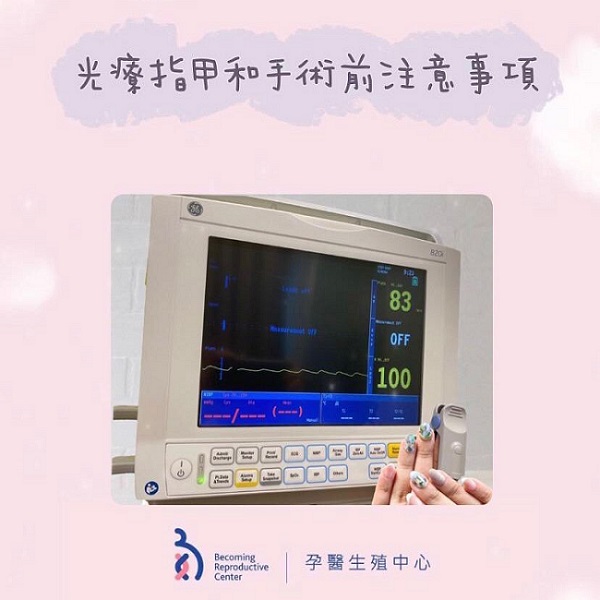
For Xiao-Fen’s safety, the nurse recommended that if she had gel nails, one nail on each hand should be removed before surgery.
This is because gel nails are often covered with a thick layer of decoration, which may interfere with the sensor of the pulse oximeter used during surgery.
As a result, the anesthesiologist may not be able to effectively monitor the patient’s blood oxygen level during the procedure.
Therefore, we hope patients can remove gel nails before surgery to avoid affecting anesthesia and surgical safety.
In addition to removing gel nails, the nurse will carefully confirm and check information before surgery, including:
Basic personal information, past medical history, fasting time, jewelry, removal of contact lenses, and removable dentures.
📌 How long should I fast before surgery?
Because anesthesia may cause vomiting during surgery, if the patient has not fasted, food in the stomach may be aspirated into the airway.
This may cause airway obstruction or aspiration pneumonia, leading to serious complications.
Therefore, you should not drink water or eat anything for at least 8 hours before surgery.
📌 Why should jewelry be removed before surgery?
If you are wearing metal accessories, such as rings, earrings, necklaces, bracelets, or other jewelry, metal can easily conduct electricity.
If electrocautery is used during surgery for hemostasis, it may cause electrical burns to the skin.
Therefore, it is recommended to remove these items before surgery.
📌 Why should contact lenses and removable dentures be removed before surgery?
Contact lenses may scratch the cornea during surgery and injure the eyes.
Removable dentures may become loose during surgery and fall into the airway or esophagus, causing danger.
📌 Why is it important to receive the trigger shot at the scheduled time and arrive on time on the day of surgery?
The doctor will perform egg retrieval 34–36 hours after the trigger shot.
You must not be late, because more than 40 hours after the trigger shot, follicles may ovulate on their own into the abdominal cavity.
Therefore, you must complete check-in for egg retrieval at the scheduled time.
Otherwise, no eggs may be retrieved, and all previous efforts may be lost.
📝 To provide a safe surgical process, many preoperative preparations require cooperation between medical staff and the patient.
This helps the surgery proceed more smoothly and safely 👍🏻
BRCIVF wishes your dreams come true!