Do Embryos Also Need Laser Treatment? What Is AHA, Assisted Hatching?
BRCIVF embryologist Ying-Jie Chen shares:
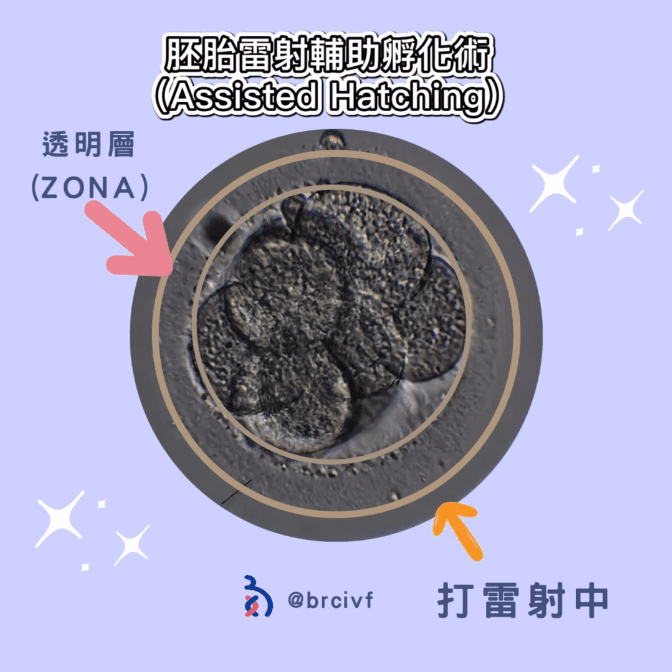
Every egg is protected by an outer shell, just like a chicken egg.
Some people have a thinner egg shell, while others have a thicker or harder one.
When the egg and sperm combine to form an embryo and develop into a blastocyst, the embryo cell mass differentiates into trophectoderm cells and the inner cell mass.
At this stage, the embryo cell mass grows strongly, causing the embryo shell, which is the original egg shell, to become thinner and naturally crack open so the embryo can hatch.
After hatching, the trophectoderm cells implant into the endometrium and continue developing into the placenta. The inner cell mass develops into the fetus.
If the growth force of the embryo cell mass is not strong enough to break through the embryo shell, the embryo may have difficulty hatching and may not implant smoothly.
If an embryo has a good grade but simply cannot hatch out of its shell, wouldn’t that be a pity?
To prevent this from happening, during frozen-thawed embryo transfer cycles, BRCIVF embryologists use a laser on the embryo shell to create a thin row of small openings.
This allows the embryo to hatch smoothly from the laser-treated area.
This is what we call AHA, Assisted Hatching.
Of course, the laser location requires professional judgment.
The laser is applied at a site away from the inner cell mass, which will later develop into the fetus.
Because every laser pulse generates heat, we do not want the heat to affect the most precious fetal cells.
The laser microscope also needs regular maintenance and calibration by the original manufacturer.
After all, only 100% precise laser firing can ensure embryo health and stability.
If the patient has already decided to undergo preimplantation genetic testing for aneuploidy, PGT-A, AHA is usually performed on day 3 or day 4 of embryo development.
When the embryo reaches the blastocyst stage, the trophectoderm cells can hatch out, allowing the embryologist to smoothly biopsy a few trophectoderm cells for testing.
If PGT-A is not being performed, and all embryos from that cycle are frozen, AHA will not be performed.
After all, the fewer invasive procedures performed, the less stress there is on the embryo.
During frozen-thawed embryo transfer, AHA is performed on the embryo selected for transfer.
Because after an embryo goes through freezing and thawing, its shell may become harder.
To ensure that the embryo can hatch and implant smoothly, AHA becomes a necessary step.
In general, AHA before transfer is recommended for women over 38 years old, patients whose embryos have thicker shells, or those who have experienced multiple failed IVF cycles.
It helps support embryo hatching.
BRCIVF wishes your dreams come true!