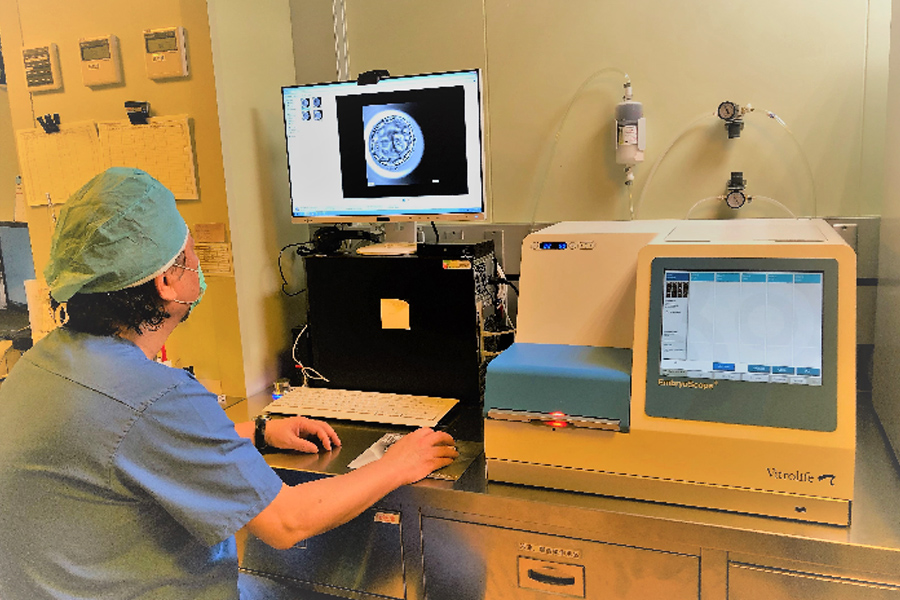
The time-lapse incubator is a device that continuously observes embryo division and early development. It records the whole process on video, providing rich, complete data that — combined with AI and big-data references — standardizes embryo assessment and makes the results more reliable.
Traditional incubators are essentially a greenhouse simulating the uterine environment, with temperature, humidity, gas concentration and pH tightly controlled so embryos grow in optimal conditions. To observe development and division, embryos had to be taken out once a day and examined under a microscope to judge their quality and select good embryos for transfer. But every time the incubator is opened to remove an embryo, the embryo is exposed to the external environment and the incubator's stability is disturbed. Moreover, embryo development is highly dynamic, and a once-a-day static observation only shows the embryo's outward form, providing very limited data.
The time-lapse incubator completely overcomes these shortcomings. It uses a time-lapse system that photographs each embryo every 10 minutes, together with a "one-step" culture medium that needs no box-opening or medium change through day 5, so embryos grow in a stable, undisturbed environment. By stringing 24-hour interval photos into a video, we can see "dynamic" changes such as the speed of division, whether the cell count is normal, and the presence of fragmentation.
Time-lapse imaging with one-step medium lets us observe embryos continuously without disturbing their development, while generating large amounts of embryo-growth data. Using AI algorithms, we can then select the highest-quality embryos to transfer — increasing pregnancy and live-birth rates and lowering the miscarriage rate.
The time-lapse incubator provides:
- 1.An absolutely stable growth environment that favors embryo division and development.
- 2.Assessment of the embryo's "dynamic" behavior and shape via time-lapse, not merely a static appearance.
- 3.AI plus big data to standardize assessment for greater reliability.
It raises the embryo-selection rate, increases transfer success, and effectively lowers miscarriage. For older patients, those with poor ovarian function or poor stimulation response, or those with few eggs who cannot undergo PGS (preimplantation genetic screening), the time-lapse incubator can help select the best embryo to transfer and shorten the time to pregnancy. For patients with more eggs who wish to do PGS, it can pick embryos with normal division and development for testing — so not every blastocyst needs to be sent for testing, saving considerable cost.
Reproductive centers in Europe, Israel and Singapore already use time-lapse incubators widely, and it has become a new trend in assisted reproductive technology. The Reproductive Medicine Center at Taipei Chung Shan Hospital has acquired the latest AI-equipped Embryoscope time-lapse incubator, put into service this December, hoping to offer infertile couples more refined, effective care and improve pregnancy rates.