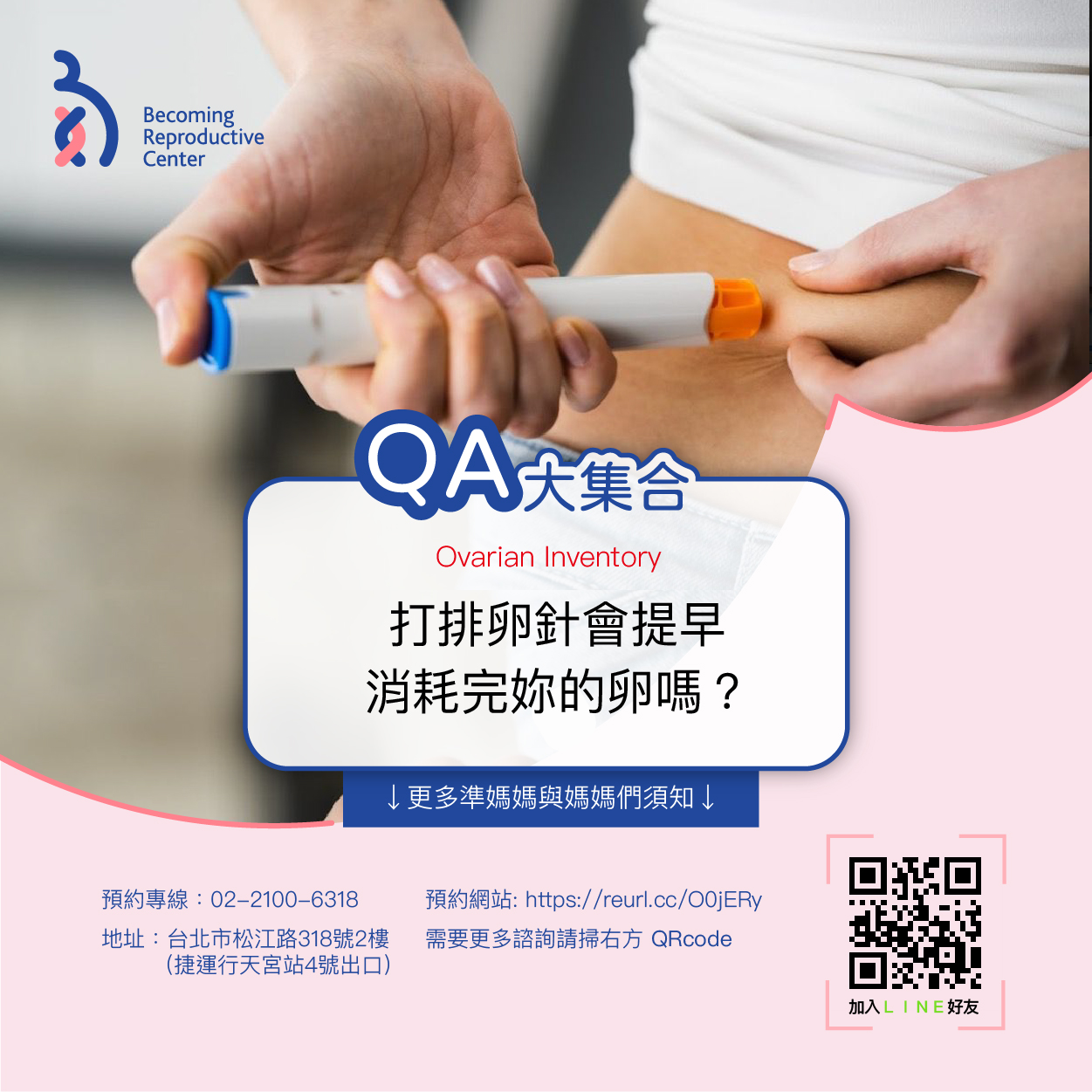
Many women who are preparing for pregnancy have questions about whether “ovulation injections will cause the ovarian reserve to be depleted earlier.” Becoming Reproductive Center has compiled the following information to help answer this question:
📌A woman’s primordial germ cells are already present in the ovaries during the embryonic stage and are present from birth. A newborn girl has approximately six million primordial germ cells in both ovaries combined.
📌At the beginning of each menstrual cycle, approximately 20-40 antral follicles (Antral follicle) may appear in the ovaries of a young woman. Stimulation by pituitary-secreted gonadotropins (GnRH) is generally sufficient to allow only one or two of them to mature and ovulate, while the remaining antral follicles that do not receive sufficient stimulation gradually undergo atresia. From puberty until menopause, ovulation occurs over a period of approximately 40 years. During this time, around twenty thousand antral follicles in total may be recruited into ovulatory cycles, while most of the remaining ovarian reserve undergoes atresia without ever being used.
📌During fertility treatment, ovulation injections (including high-dose FSH or LH) are used to help antral follicles that would otherwise not receive sufficient stimulation during that cycle grow and mature. This allows more eggs to be retrieved and utilized. It can be viewed as a form of “resource recovery” and does not consume additional eggs beyond those already recruited for that cycle, nor does it reduce the ovarian reserve or cause menopause to occur earlier.
If you still have other questions, feel free to add Becoming Reproductive Center on Line@ and ask us!