What Should You Do About Repeated Implantation Failure, RIF?
Dr. Kuo-Chang Wu would like to share the following with everyone:
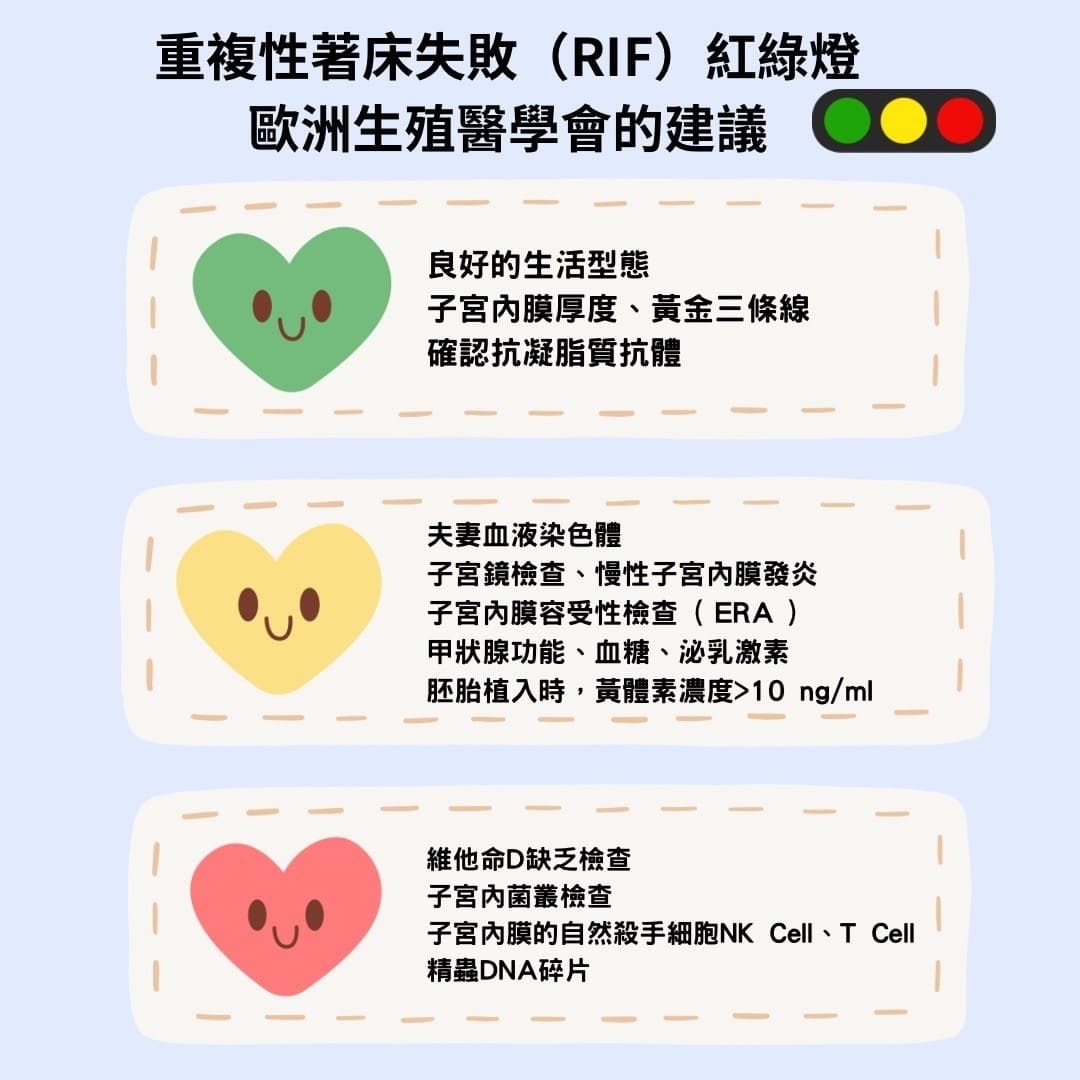
According to the recommendations of the European Society of Human Reproduction and Embryology, once a patient is diagnosed by a physician as having repeated implantation failure, RIF, the suggested evaluations can be divided into three categories:
“🟢 Green light” means there is a level of evidence supporting the recommendation, and it can be recommended for implementation.
“🟡 Yellow light” means it can be considered.
“🔴 Red light” means the current level of evidence is very weak. It should only be used in special situations, with full communication and discussion with the patient.
📌 What belongs to the green light category?
Green light 🟢
- 1.Lifestyle modification
Some factors should be evaluated, such as smoking, alcohol consumption, exercise, calorie intake, BMI, and whether these are within an ideal range. - 2.Endometrial thickness
Whether the endometrial thickness is greater than 7 mm, and whether the endometrial pattern shows a trilaminar structure, can be assessed with hysteroscopy or ultrasound. - 3.Antiphospholipid antibodies
These antibodies may create a tendency toward miscarriage. Therefore, these antibodies should be evaluated, and appropriate immune-based management may be considered.
📌 What belongs to the yellow light category?
Yellow light means these tests can be considered when necessary.
First, both partners may undergo chromosome testing. Although the proportion is not high, about 1%, if a chromosomal abnormality has already been diagnosed previously, then chromosomal testing of the embryo should definitely be performed this time.
Second, hysteroscopy or 3D ultrasound can help evaluate the shape of the uterus and the thickness of the endometrium.
Third, functional testing of the endometrium may be considered, such as proteomic testing, genetic information testing, and gene expression testing, such as the ERA test.
- 1.Chronic endometritis
This can be evaluated through pathological examination or bacterial culture. In general, it can be treated with antibiotics for two weeks. - 2.Thyroid function testing
Both hyperthyroidism and hypothyroidism may affect conception.
Diabetes, prolactin levels, and other hormone- and metabolism-related evaluations should also be assessed.
- 1.Blood progesterone concentration
Especially around the time before and after embryo implantation, the progesterone level should be greater than 10 ng/ml.
Basically, the tests that the European reproductive medicine guidelines strongly recommend or suggest considering are shown as 🟢 and 🟡.
📌 Red light 🔴
Red light means these are only considered under special circumstances.
For example:
• Vitamin D testing
• Vaginal microbiome testing
• Whether to take probiotics in hopes of increasing vaginal Lactobacillus
• Blood natural killer cell, NK cell, testing
• Uterine natural killer cell, NK cell, testing
• Uterine T cell testing
• Blood cytokine testing
• Blood profile testing
• HLA typing
• Cell-free DNA testing from the blastocoel fluid or culture medium
• Sperm chromosomal fragment and DNA fragmentation testing
These are tests that are only considered in special situations and are provided here for reference.
Dr. Wu wishes you good pregnancy luck.